A Brief History of CSS
Before diving deeper, let’s take a moment to look back at how CSS (Cascading Style Sheets) came to be.
The Early Web: Styling Without CSS
In the early days of the web, pages looked plain and “academic.” Personalization was minimal, and most sites shared the same rigid appearance.
- HTML 3.2 introduced presentational tags like
<font>and<center>, along with inline attributes for colors. - While these additions allowed some styling, they quickly became messy and unsustainable.
- HTML was overloaded with presentation details, making it harder to maintain and obscuring its true purpose: defining the structure of a document.
The Birth of CSS
CSS emerged to solve this problem by separating content (HTML) from presentation (CSS). This shift allowed developers to style pages consistently while keeping HTML clean and semantic.
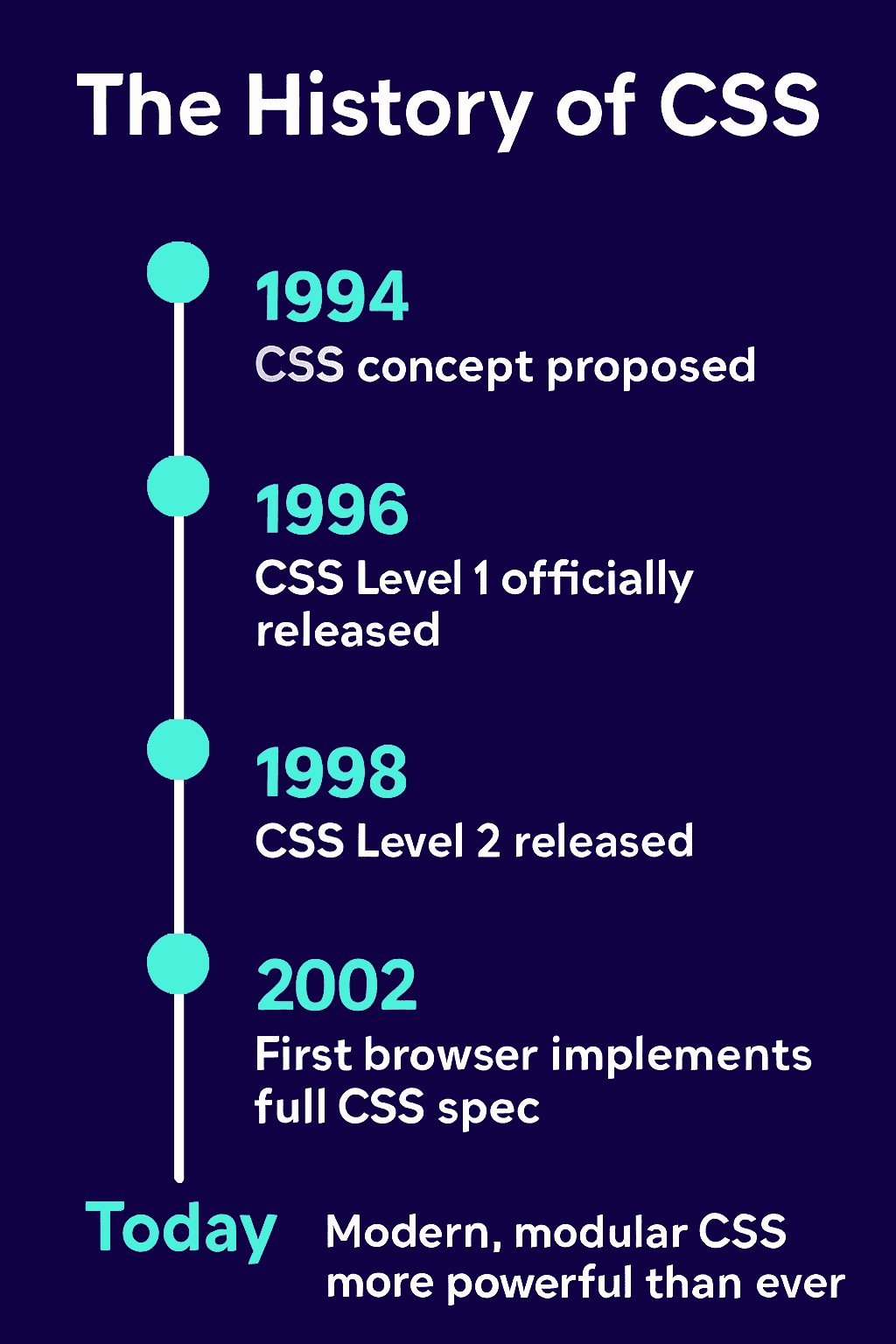
- The idea of CSS was proposed in 1994.
- CSS Level 1 (CSS1) was officially released in 1996.
- CSS Level 2 (CSS2) followed in 1998, laying the foundation for much of the CSS we still use today.
Browser Wars and Early Challenges
The late 1990s were dominated by competing browsers like Internet Explorer and Netscape Navigator.
- Each browser introduced its own non-standard tags, forcing developers to build sites tailored to one browser or the other.
- Styling options were limited, and most design decisions were left to the browser itself.
- Internet Explorer famously implemented the box model incorrectly, leading to years of frustration and countless hacks to achieve consistent layouts.
It wasn’t until 2002 that a browser (IE for Mac) fully implemented the CSS specification, marking a turning point for web design.
CSS Evolves
From the early 2000s onward, CSS steadily matured:
- The CSS Working Group began splitting features into modules, allowing faster development and adoption.
- New techniques and idioms emerged, and browsers gradually improved their support.
- What worked five years ago might now be outdated, as CSS continues to evolve with modern standards.
CSS Today
Modern CSS is more powerful than ever:
- Developers can rely on standards without worrying about quirks in most cases.
- Features like Flexbox, Grid, and Custom Properties have transformed how we build responsive, accessible layouts.
- Instead of version numbers, the CSS Working Group now publishes snapshots of stable modules. The latest snapshot (2018) highlights the features ready for widespread use.
The Legacy
Even today, CSS2 remains the foundation of the language, with countless features built on top of it. The journey from messy inline styles to today’s modular, standards-driven CSS shows just how far the web has come.
CSS Timeline: Key Milestones
- 1994 → The Idea Håkon Wium Lie proposes CSS as a way to separate content from presentation.
- 1996 → CSS Level 1 Released The first official recommendation, introducing basic styling like fonts, colors, and spacing.
- 1998 → CSS Level 2 Released Added positioning, z-index, media types, and more advanced selectors.
- 2000s → Browser Wars & Hacks Developers rely on workarounds to achieve consistent layouts across IE, Netscape, and others.
- 2002 → First Full Implementation Internet Explorer for Mac becomes the first browser to fully support CSS1. (Meanwhile, IE’s incorrect box model causes years of headaches.)
- 2010s → Modern CSS Emerges Flexbox, Grid, and Custom Properties revolutionize responsive design and layout control.
- 2018 → CSS Snapshot The CSS Working Group publishes a snapshot of stable modules, replacing version numbers.
- Today → Ever-Evolving Standards CSS continues to grow modularly, with new features like container queries, subgrid, and advanced animations.